

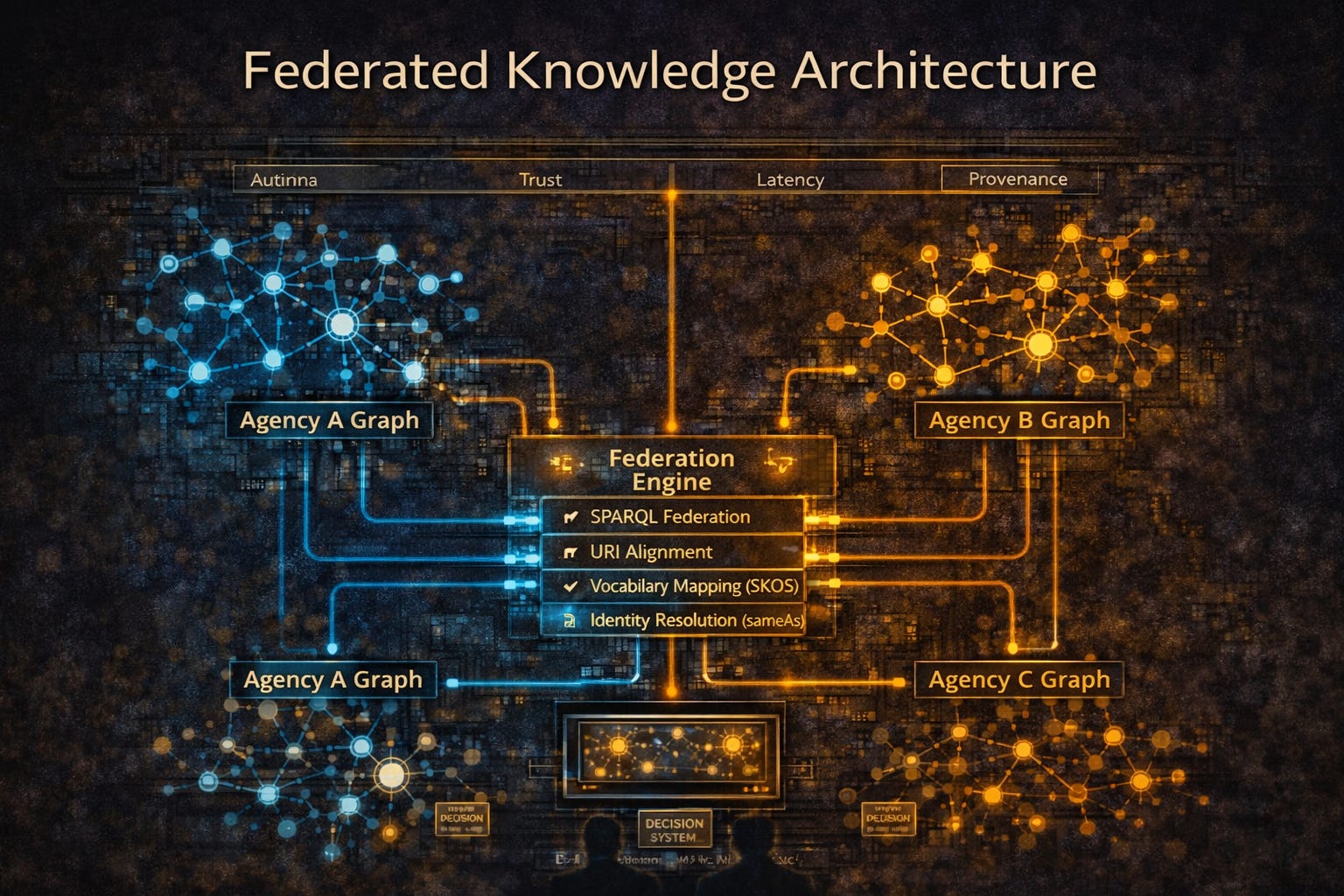
TL;DR: Federated knowledge is the capability to query, share, and reason over knowledge that is distributed across systems, organizations, and domains without requiring a central authority to own or standardize all of it. In machine learning systems operating across organizational boundaries, federated knowledge is the difference between a system that can only reason over what it directly controls and a system that can incorporate authoritative knowledge from wherever it lives. Building it requires shared identifier schemes, vocabulary alignment standards, and query federation infrastructure that most machine learning stacks were never designed to support.
[AUDIO OPENING - Remove before posting text version]
A joint logistics operation involves three agencies. Each agency maintains its own knowledge graph describing assets, locations, supply chains, and operational status. Each graph was built independently using different schemas, different terminology, and different identifier schemes. A mission planner needs to know which assets across all three agencies are available, mission ready, and within operational range of a specific target area. Getting that answer requires querying three separate systems, reconciling conflicting terminology, resolving duplicate asset records where the same physical asset appears in two agency graphs under different identifiers, and manually combining results that no single system can produce. The mission planner needs this in minutes. The reconciliation takes hours. Federated knowledge is the infrastructure that makes that query a single operation instead of a three-agency data integration project.
[END AUDIO OPENING]
We covered in Part 19 how RDF’s URI-based identification enables knowledge to cross system boundaries without losing its meaning. Federated knowledge is what happens when you extend that capability across organizations that do not share a common schema, a common ontology, or a common definition of what their data means. It is the hardest problem in the semantic layer and the one most directly relevant to machine learning systems operating in complex multi-agency environments.
What Federation Actually Means
Federation in knowledge systems means the ability to treat distributed, independently managed knowledge sources as a unified queryable layer without physically centralizing the data. Each organization retains ownership and control of its own knowledge graph. No central authority dictates how they must structure or label their data. But a federated query layer can traverse all of them simultaneously, resolving terminology differences and identifier conflicts at query time rather than through upfront data migration.
This is fundamentally different from data integration approaches that copy and consolidate data into a central warehouse. Data warehouses require agreement on a master schema before data can be loaded. Schema changes in any source system break the integration pipeline. Governance overhead grows with every new source. The central warehouse becomes a bottleneck that every organization’s data must pass through before it can be used.
Federation leaves data where it lives and brings the query to the data. SPARQL federation, defined in the W3C SPARQL 1.1 specification, lets a single query span multiple independently operated SPARQL endpoints. A federated query sent to a primary endpoint can include SERVICE clauses that direct portions of the query to remote endpoints, retrieve results, and combine them with local data before returning a unified response. Each endpoint applies its own access controls. Each organization’s data stays within its own infrastructure. The federation layer handles the coordination.
The Vocabulary Alignment Problem
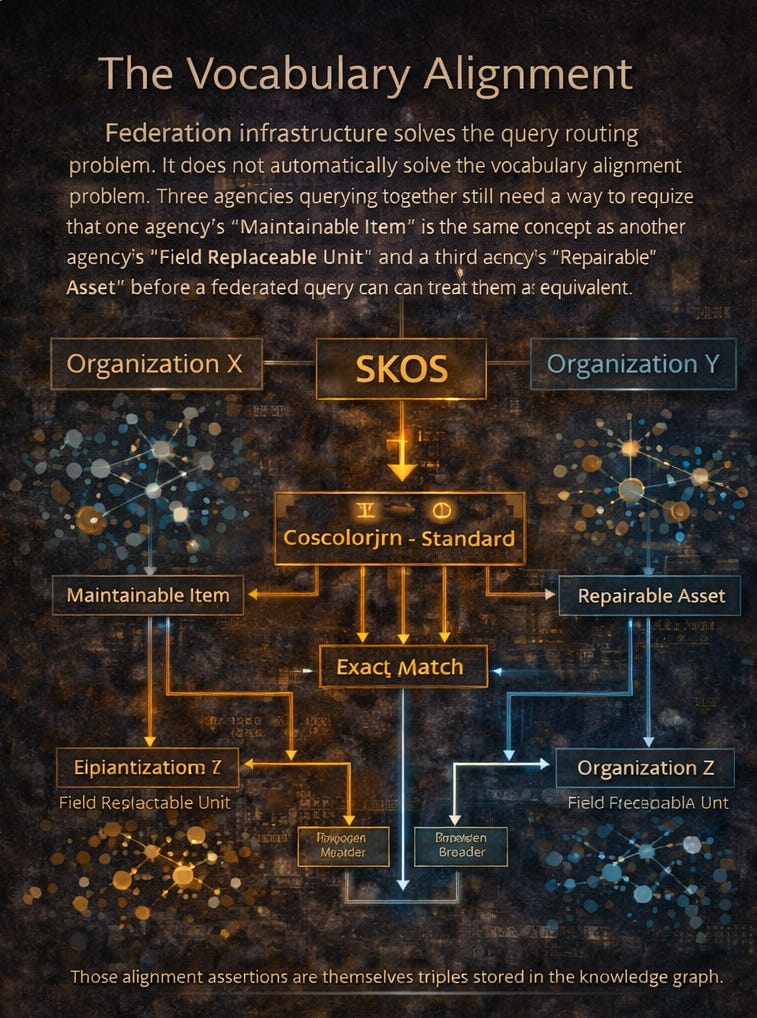
Federation infrastructure solves the query routing problem. It does not automatically solve the vocabulary alignment problem. Three agencies querying together still need a way to recognize that one agency’s “Maintainable Item” is the same concept as another agency’s “Field Replaceable Unit” and a third agency’s “Repairable Asset” before a federated query can treat them as equivalent.
This is where SKOS becomes operationally essential rather than theoretically interesting. We introduced SKOS briefly in Part 17 as a controlled vocabulary standard. In a federated knowledge context its role expands. SKOS allows each organization to publish its vocabulary as a machine-readable document that explicitly maps its terms to terms in other vocabularies. One organization asserts that their “Maintainable Item” is a close match to the GEIA standard definition of the same concept. Another asserts that their “Field Replaceable Unit” is an exact match. A third asserts that their “Repairable Asset” is a broader term that includes but is not limited to the same concept.
Those alignment assertions are themselves triples stored in the knowledge graph. A reasoning engine traversing a federated query can follow those alignments automatically, recognizing equivalent concepts across agency boundaries without a human data steward manually reconciling terminology before every query. The alignment work happens once when vocabularies are published. Every subsequent query benefits from it without additional human intervention.
Identifier Resolution Across Boundaries
V4.20
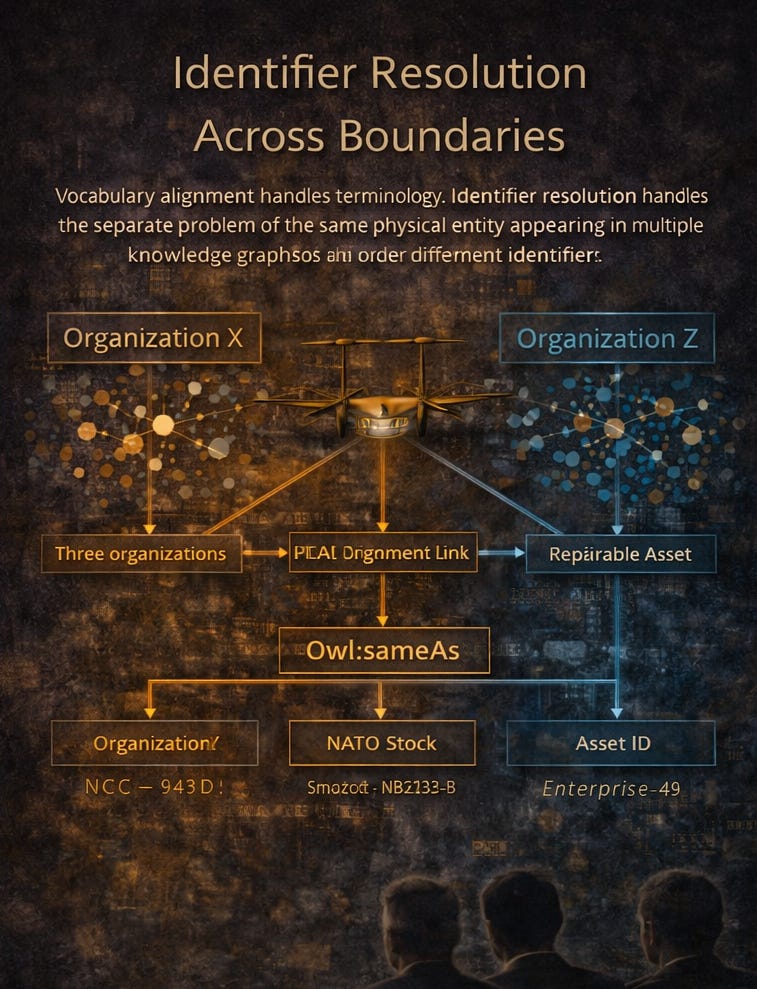
Vocabulary alignment handles terminology. Identifier resolution handles the separate problem of the same physical entity appearing in multiple knowledge graphs under different identifiers.
A specific aircraft might be identified by tail number in one agency’s graph, by a NATO stock number in another, and by an internal asset management identifier in a third. Without identifier resolution, a federated query asking about that aircraft returns three separate records that appear to be three different assets. With identifier resolution, the query recognizes them as the same entity and merges the knowledge from all three sources into a unified view.
OWL’s sameAs relationship is the formal mechanism for asserting cross-system identifier equivalence. When one organization’s knowledge graph asserts that their identifier for an asset is the same entity as another organization’s identifier for the same asset, reasoning engines can treat all triples about either identifier as triples about the same real-world entity. Building and maintaining those sameAs assertions requires either manual curation by domain experts who know both systems or automated entity resolution pipelines that match records across graphs using shared attributes like serial numbers, geographic coordinates, or temporal signatures.
Automated entity resolution at scale is an active machine learning problem. Probabilistic matching models trained on known cross-system entity pairs can identify likely matches in new data with high recall. But in high-stakes federated environments, false positive matches that assert two different physical assets are the same entity create downstream errors that are difficult to detect and expensive to correct. Human validation of automated matches is standard practice in production federated knowledge systems where accuracy requirements are strict.
What Federated Knowledge Enables for Machine Learning
The value for machine learning systems is access to authoritative knowledge that no single organization could maintain alone. A machine learning model predicting supply chain disruption risk benefits from incorporating real-time logistics knowledge from multiple agencies, regulatory databases, and commercial shipping networks simultaneously. Without federation, that model trains on whatever knowledge its owning organization can collect and maintain internally. With federation, it trains and infers against the full distributed knowledge landscape that describes the problem domain.
This capability is particularly significant for machine learning systems in domains where ground truth is distributed by definition. No single agency owns complete knowledge of a joint operational environment. No single organization maintains authoritative data about a global supply chain. No single regulatory body holds complete compliance knowledge across all applicable jurisdictions. Federated knowledge lets machine learning systems reason over the full picture rather than the fragment any one participant can see.
Where Federation Breaks Down in Practice
Latency compounds across federated endpoints. A query spanning five remote SPARQL endpoints is at the mercy of the slowest endpoint’s response time. Network partitions, endpoint maintenance windows, and performance degradation in any participating system affect the entire federated query. Machine learning pipelines that depend on federated knowledge for real-time feature assembly need careful circuit breaker logic that gracefully degrades when remote endpoints are unavailable rather than blocking indefinitely.
Trust and provenance become critical at scale. When knowledge arrives from multiple independent sources, a machine learning system needs to know not just what a triple asserts but who asserted it, when, and with what authority. A supply availability assertion from an authoritative logistics system carries different weight than the same assertion from an unverified field report. Without provenance tracking, federated knowledge collapses all sources into an undifferentiated pool that the machine learning system cannot reason over selectively. We cover provenance in depth in Part 23.
Governance without central authority is genuinely hard. Federated systems require participating organizations to maintain their SPARQL endpoints, keep their vocabulary alignments current, and honor the identifier schemes they committed to when joining the federation. When organizations fail to maintain their contributions, the federated layer degrades silently. Queries return incomplete results without indicating which sources failed to respond or why. Detecting and managing participant health requires federation-level monitoring infrastructure that most organizations underinvest in.
Why This Matters
Machine learning systems that can only reason over knowledge they directly own are fundamentally limited in domains where authoritative knowledge is distributed across organizational boundaries. Federation is the infrastructure that removes that constraint. It lets machine learning systems incorporate the full depth of distributed domain knowledge without requiring any organization to surrender control of their data or adopt someone else’s schema.
In environments where interoperability is a mission requirement rather than a nice-to-have, federated knowledge is not an advanced capability to consider after the core system is built. It is an architectural foundation that must be designed in from the beginning, because retrofitting federation onto systems built without it is significantly more expensive than building for it from the start.
In Part 21, we move from how knowledge is distributed across systems to how machine learning systems choose between certainty and probability when reasoning over that knowledge. Stochastic versus deterministic reasoning is the decision that determines whether your system gives you an answer or a distribution of possible answers, and why that difference matters more than most architects realize.
#MachineLearning #FederatedKnowledge #SemanticML #KnowledgeGraphs #SPARQL #MLInfrastructure #EnterpriseAI


