
Orchestrating Multi-Agent Workflows (Agents Part 4)
How Workflow Orchestration Turns Data into Action

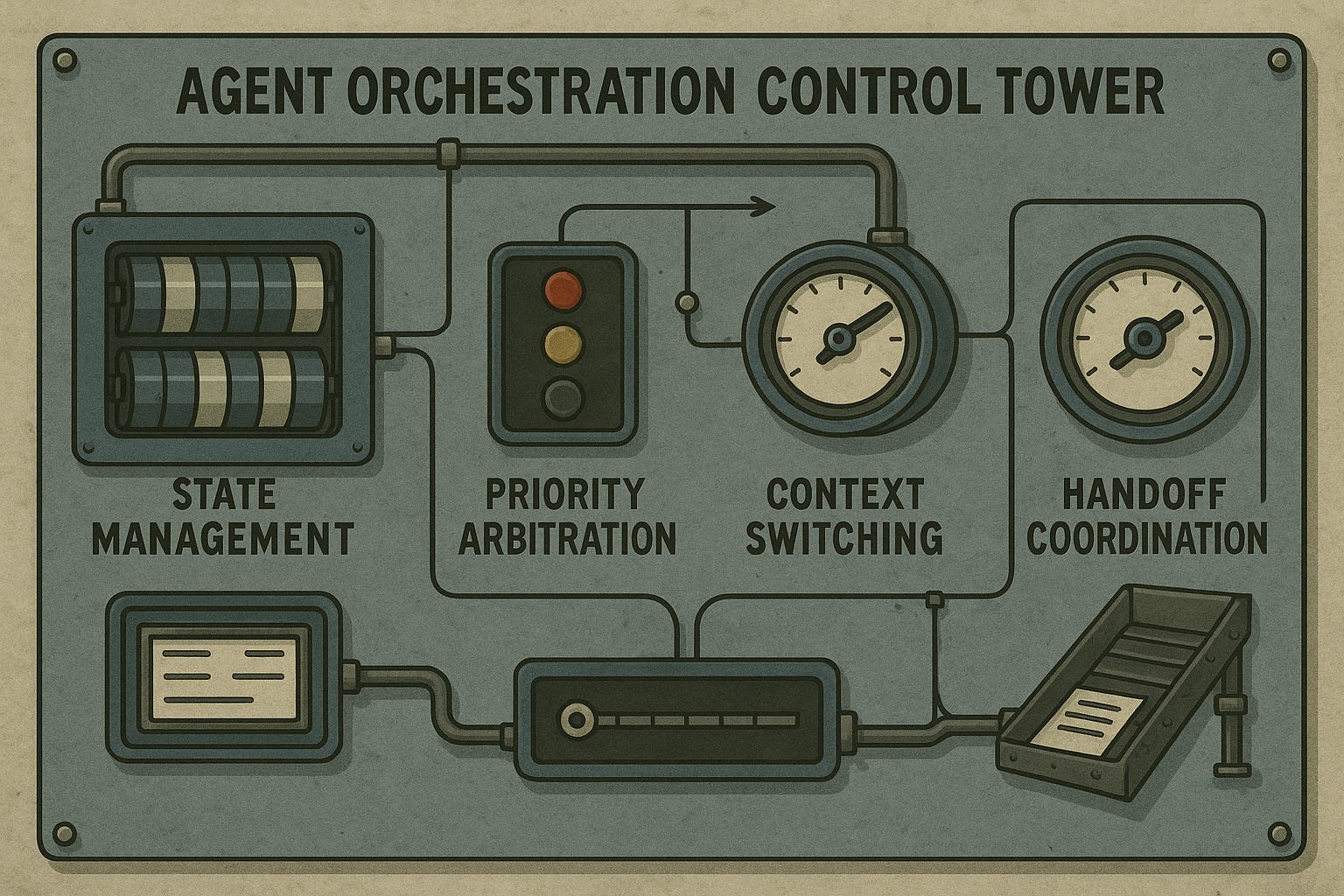
TL;DR: Clean data gets you in the game, but orchestration wins it. Agents stumble when they lose context, chase the wrong priority, or botch handoffs. Most companies are still stuck with single-shot Q&A bots. The ones mastering orchestration will have agents that finish real business processes -- end to end.
In Part 3, we laid the foundation by creating data pipelines that provide agents with coherent and up-to-date information. But even perfect data won’t save an agent that can’t keep track of what it’s doing, decide what matters most, or work with others. That’s where orchestration comes in.
Orchestration is what turns an agent from a sophisticated search tool into a participant in your business processes. Traditional workflow engines follow predictable, pre-set steps. Agent workflows change based on what the agent learns while working; the next step isn’t programmed in advance, it’s chosen in the moment. That makes orchestration less about “if-then” flowcharts and more about managing context, priorities, and coordination in real time.
There are four orchestration patterns that distinguish a working agent from one that freezes, wanders, or duplicates effort.
State Management
This is the agent’s working memory, the ability to carry forward what it’s doing, why it’s doing it, and what it has already decided. Without it, the agent starts fresh every time, asks the same questions, and never builds on prior work. With it, an agent analyzing a vendor contract remembers it’s working for finance, has already flagged problem clauses, and still needs to check pricing against the past two years of deals, even if it’s interrupted or restarted.
Priority Arbitration
When multiple demands hit at once, the agent needs to decide what comes first. Without this, it either works randomly or abandons one task to chase the newest request. With priority arbitration, it is understood that a customer escalation on a $2M renewal probably outranks completing a budget variance report due Friday, unless the board packet is due tomorrow.
Context Switching
Real workflows aren’t linear. An agent might be deep into competitive pricing research when it’s pulled to resolve a support ticket. Without context switching, it returns later having forgotten where it left off, why it chose that line of research, or how the results connect to the bigger proposal. Effective context switching preserves the reasoning, partial results, and next steps so it can resume without starting over.
Handoff Coordination
In multi-agent or agent-plus-human workflows, one handoff can make or break the outcome. Without coordination, work gets duplicated, key details get lost, and each participant assumes the other is covering something. With it, Agent A can pass a contract to Agent B for regulatory review along with the risk tolerance, business context, and deadlines that shaped the initial analysis.
These patterns build on each other. You start with state management; nothing else works without persistent memory. Then add priority arbitration so the agent can make smart trade-offs. With memory and priorities in place, you can introduce context switching to handle interruptions gracefully. Only once single-agent workflows are stable should you tackle handoff coordination across multiple agents or teams.
Orchestration is harder than most expect. A chatbot that gives the wrong answer is annoying; an orchestrated agent that forgets its place, drops priorities, or botches a handoff can derail entire business processes. The technical challenge here isn’t about making the agent smarter; it’s about making it dependable in complex, multi-step work.
The companies that get this right will have agents who finish what they start and work seamlessly with other systems and people. The rest will have expensive demos that can’t complete a business process from end to end.
Next in this series: even perfect orchestration fails without governance and audit trails for agent decision-making.